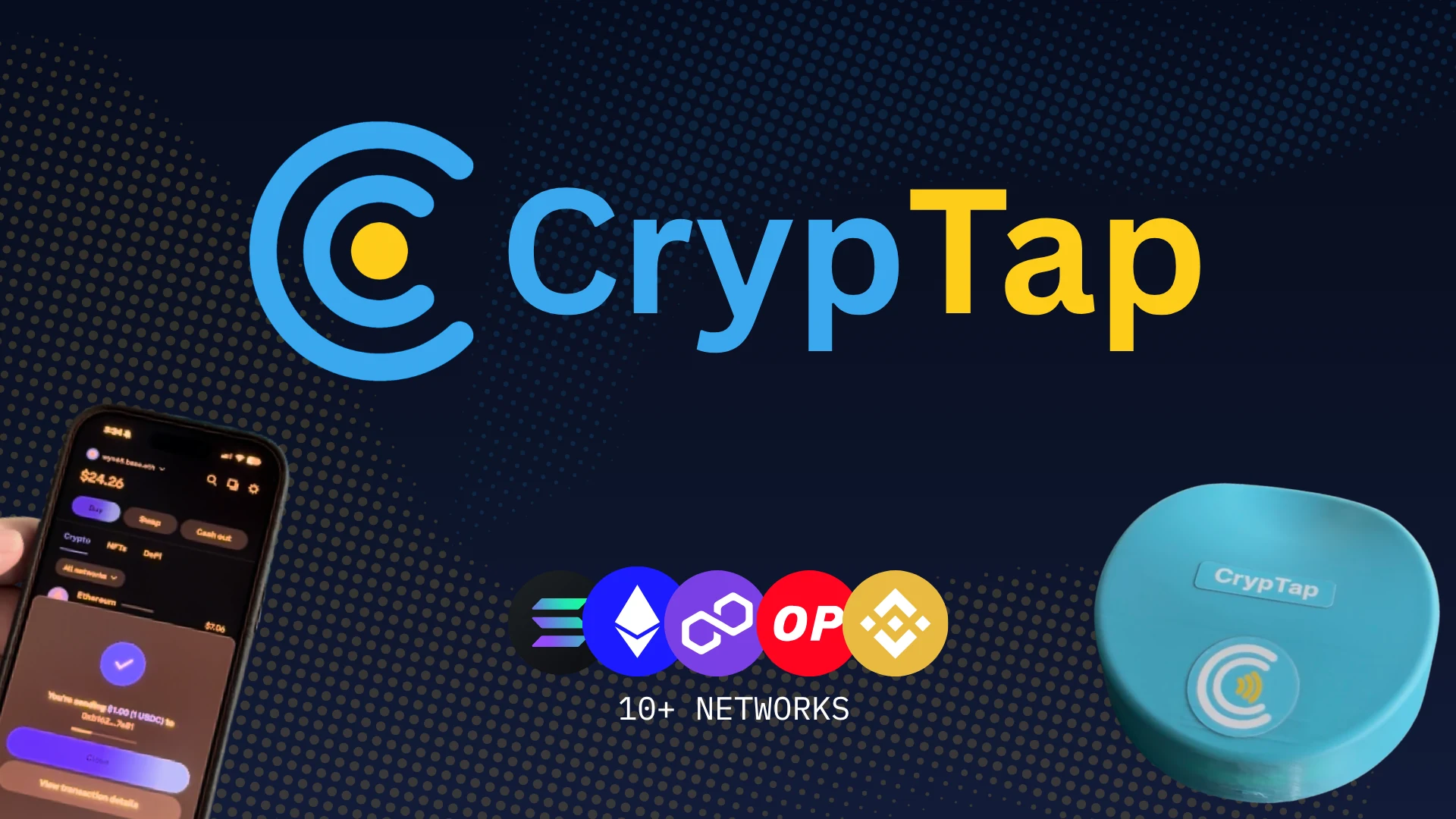
Overview
CrypTap is a full crypto payment platform for real businesses — cafés, shops and online stores that want to accept crypto without handing their money to a middleman. Most "accept crypto" providers are effectively crypto banks: they receive funds in their own name, custody them, and pay the merchant out later. CrypTap is built on the opposite principle, and the entire architecture defends one invariant:
CrypTap never holds, signs for, or transmits merchant funds. Everything that touches money happens client-side and on-chain; the backend only tracks payment intents and verifies their status.
There is no part of this platform I didn't build: the EVM contracts, the Solana program, the POS, the payment page, the hardware terminal and its firmware, the e-commerce product, the store plugins and SDK, the dashboards, the admin panel and the backend.
On-chain foundation
EVM — 7 chains
Deployed on Polygon, Ethereum, BSC, Arbitrum, Optimism, Avalanche and Base. Each payment gets its own on-chain invoice, created through a gas-efficient contract pattern that keeps per-payment cost to a fraction of a full deploy. The pay-to address is known before anything is on chain, so the customer can be shown a QR code instantly. Native coins and ERC-20 (USDC/USDT/DAI…) are both supported.
Solana
A native Anchor (Rust) program supporting SOL and SPL tokens, with the same intent-tracking flow as EVM. Not a bridge or a wrapper: a first-class second contract stack.
In-store: POS + hardware
- Merchant POS — a fully client-side web app. It creates the invoice on-chain, shows live payment status, and handles tips, tax and fiat conversion with real-time rates. Settling, cancelling and refunding all happen from the browser with the merchant's own key.
- CrypTap device — a dedicated hardware terminal that pairs with the POS, so the merchant's key stays out of the browser and off CrypTap's infrastructure entirely. This is the difference between a demo and something a business can actually run.
- Customer payment page — QR code with countdown, wallet deep links, live on-chain confirmation, and export/send-remotely options. Includes recovery flows for edge cases (funds received but not yet distributed) so no payment is ever stranded.
E-commerce: trustless settlement with zero merchant infrastructure
Online stores break the POS assumptions — nobody is at the counter holding a key when a shopper pays at 3 AM. CrypTap Commerce solves it without ever taking custody:
- Trustless settlement — each commerce payment is bound on-chain to its own parameters, so settlement can be triggered by anyone without signatures, attestations or trust, and a bad actor simply gets nowhere.
- On-chain gas tank — merchants pre-fund gas for their own settlements from the dashboard, keyed to their payout address; only they can withdraw.
- Keeper — a settle bot that finds funded checkouts and triggers settlement on EVM and Solana. It holds no merchant keys and custodies nothing; its telemetry is exposed in the owner dashboard.
- Hosted checkout + REST API — machine-to-machine API keys, idempotent checkout creation, and HMAC-signed outbound webhooks so a store backend knows the moment a payment lands.
- Integrations — WooCommerce and Shopify plugins, plus a
commerce-jsSDK for custom storefronts.
Operations layer
- Owner dashboard — revenue analytics, device management, payout wallets, transaction history, sweeps, fee tiers and keeper telemetry.
- Admin panel — merchants, users, transactions, logs and commerce oversight.
- Backend — Flask + SQLAlchemy. It receives intents, stores them, and independently verifies their status on-chain with a checker and scheduler. It can see everything and touch nothing — by design it has no keys and no custody.
Security model in one breath
Client-side signing everywhere; hardware key isolation for in-store merchants; permissionless settlement that makes wrong inputs worthless rather than merely forbidden; a backend that is a read-only observer of the chain.
Tech Stack
- Solidity (Foundry) — invoice and settlement contracts across 7 EVM chains
- Anchor / Rust — Solana invoice program (SOL + SPL)
- Next.js + TypeScript — POS, payment page, hosted checkout, owner dashboard, admin panel
- Flask + SQLAlchemy — intent tracking backend, on-chain checker, keeper
- Embedded firmware — hardware payment terminal
- ethers.js / @solana/web3.js — all chain interaction, in the browser
Cryptography, hardware, smart contracts, plugins and plain old web engineering — one person, one coherent platform. This is the project I point to when someone asks what I can build.
Implementation details of CrypTap's contract and hardware design are proprietary and intentionally omitted here.